Washington DC in the Prime Minister’s Shadow
An excerpt from James Robinson's new book, Voyages in America.
The life of a Master’s student, sometime freelance journalist and aspiring correspondent was varied and interesting, if devoid of glamour. I arrived in Washington DC at 9pm on a Wednesday night in July 2011, soon before New Zealand Prime Minister John Key’s own flight touched down. But any similarity between my situation and his ends there. I don’t think he had to take a $10 shuttle from Dulles Airport to the outer limits of the Washington Metro system, ride two trains into the middle of the city and walk the rest of the way to where he was staying.
My $20-a-night hostel was a dozen or so blocks from the White House. I checked in just after 11pm. For its place as the seat of power in America, DC is a ramshackle town; it falls away quickly when you move out from the centre of power.
These accommodations were on the same block as two of the most unpleasant-looking fried chicken restaurants I’ve ever laid eyes on. As I set my stuff down in my three-person bunk room, the PM was no doubt settled into Blair House, the President of the United States’ guest house for visiting dignitaries, situated across the White House. Browsing the website with a degree of envy in my heart, I saw that it had 119 rooms, 14 guest bedrooms, 35 bathrooms, a large staff and among many other treats, a fully equipped hair salon.
Someone had smoked a Newport in the bathroom at my hostel. It was like showering inside a poisoned lung. As it neared midnight the temperature in DC remained over 30 degrees Celsius. The humidity was immense. I couldn’t sleep and I ventured out to eat. Moving past some undesirable all-night eateries, I pulled into a 7 Eleven.
For those unfamiliar with 7 Eleven, imagine a supermarket reconstructed in a small room by a drunk. It is about the only place in the world I can imagine feeling sensible for purchasing a Mountain Dew-flavoured Slurpee, a large piece of beef jerky and some potato chips.
I perhaps shouldn’t have even been in Washington DC. News had broken that the prime minister was visiting and buoyed by having been given a prominent platform from which to blog from and having found some exceptionally cheap flights, I convinced myself to go for it. My plan hit an epic snag when I was not granted access to the prime minister’s media delegation, which meant I had to source access to all of Prime Minister Key’s events individually and find my own way around town.
Either way, I woke early the next morning filled with purpose. I had a speech by the New Zealand Prime Minister to attend. The event would be swanky. There would be New Zealand accents galore.
Not being part of any official media delegation, I dressed down – life is too short to wear a suit in a heat wave if you’re not trying to impress a superior. I caught the bus to Lafayette Park, which overlooks the back entrance of the White House and lingered a while on the view.
At 8am it was 28 degrees and I was perspiring profusely. A statue of a horse-riding Andrew Jackson tipped his hat in the direction of the White House. A heavily tattooed man protested about nuclear arms. The New Zealand flag flew meekly outside Blair House. I retreated to an air-conditioned café nearby and sat with the Washington Post.
The debt crisis and heat wave led the news. Steve Williams, Tiger Woods’ recently spurned caddy, was throwing sharp elbows at his former boss in the sports section. There was no reference to Williams’ nationality, but it was nice to see one New Zealander referenced in a major American newspaper.
The security at the Chamber of Commerce threw me some disbelieving looks. They were not fans of my casual wear. Due to my unaffiliated journalistic status, I also hadn’t been updated on the change in start time to the morning’s speech. I had arrived a few minutes early for an expected 9 am start. I was in fact an hour late and just caught the end of Key’s speech. I picked up a copy on the way out to catch up on what I’d missed. It was a serviceable overview of the pressing issues of the time: earthquake reconstruction, military relationships, the economy, trade. I’d never witnessed our prime minister in action like this and he was a good operator: well spoken, he handled the Q&A component smoothly and got a few yuks in with the crowd about the coming Rugby World Cup.
It looked like a nice event. The breakfasting audience sat with remnants of fresh fruit and glasses half-filled with fancy juices. The media dispersed for a little scrum on the steps outside; I took some photos, and set off into the Washington DC morning in search of more air conditioning. Sometime in the early afternoon the heat took off over 40 degrees. I would’ve traded this weather in for the foulest winter’s day; it just made everything harder.
Next I had a wreath-laying event to attend at the US military’s Arlington Cemetery. The cemetery is a short walk over the Potomac River from Washington DC, but is actually in Virginia. The cemetery was peaceful, even with hundreds of sweaty tourists loafing through its grounds. It had those rolling hills that I instinctively want to describe as British. Rows of white crosses covered the landscape. It is a solemn but striking sight. I began hiking up to the Tomb of the Unknown Soldier, where Key would be.
Halfway up, I came across a confused backlog of tourists unable to continue to the tomb. A long honour guard awaited Key’s arrival, kitted out in heavy woolen suits, impeding any further progress into the grounds. Admission to the tomb was by motorcade only. Again, I had been foiled as an outsider.
The heat was brutal and I trekked back to the subway. A man at the station looked at me, standing impishly with his young son.
“You were there at the cemetery,” he said.
“Yeah,” I replied. He looked cross. I was confused as to what I was supposed to offer back to him.
“We didn’t make it up to the tomb. Pretty ridiculous to have to wait in the heat like that, so we turned around. We really wanted to see it though.”
I gathered that the guy just wanted to explain his frustration to anyone who would listen.
“Oh, the New Zealand prime minister was placing a wreath at the tomb,” I offered up. I suspect there was a hint of pride in my voice seeing as all that pomp, security and inconvenience was for the leader of my small island nation.
I thought that knowing that his sightseeing was waylaid by some real-life pageantry might offer some consolation for the man. It didn’t.
Back in downtown DC I was officially a mess. I felt like I might pass out from heat exhaustion. I looked like I had stepped into a shower. In the late afternoon, the temperature was reported at 46 degrees.
I had an hour before my next appointment, a press conference at Blair House – a look into the very place that the prime minister had been staying. I ordered up the tallest glass of water imaginable and went to the GAP to buy myself a new shirt.
I arrived at security 20 minutes early as instructed. The security point across from Blair House sent me to another checkpoint. The following checkpoint marched me to the next one, until I had completed a full circle of two city blocks. I had begun this journey clean and fresh but with each redirection my composure frayed. The correct checkpoint was 20 feet from the first one I had asked at.
I was shown to the Truman Room at Blair House, having returned to my previous state – a disheveled, informal mess – and was now standing next to a half-dozen New Zealand journalists, all decked out in their Sunday best. In this moment many of my life choices appeared regrettable.
A portrait of President Truman bore into my soul, informing me I was out of place.
Blair House was ornate, filled with beautiful rugs, antiques and delicately painted wallpaper.
If you were after specific or interesting information, the press conference was a dud, as press conferences often are. Two Democratic congressmen shared platitudes with John Key about the US and NZ relationship, sent sympathies to Christchurch and talked about trade deals. The sentiment was nice, but the scripts couldn’t have been blander.
There was a bucket of water bottles on the way out. I took two. My emotions were mixed. I had twice managed to be in close quarters with my own prime minister and for the first time in DC, I had crossed one of its abundant security checkpoints. But I had crumpled in the heat, standing out like a dripping eyesore among stiff informality. I read disapproval in the eyes of everyone I came across in these situations. But maybe I was projecting my own insecurity. I wasn’t sure what I’d achieved. I did have a new appreciation that outside of the chauffeured, air-conditioned bubble of the press corps diplomacy was a sweaty and slightly boring racket.
The (much-hyped in New Zealand, completely ignored in America) meeting between President Obama and John Key was set for Friday afternoon in the White House. This was well off limits to me so I sheltered inside Museum Mile on the National Mall working on another story.
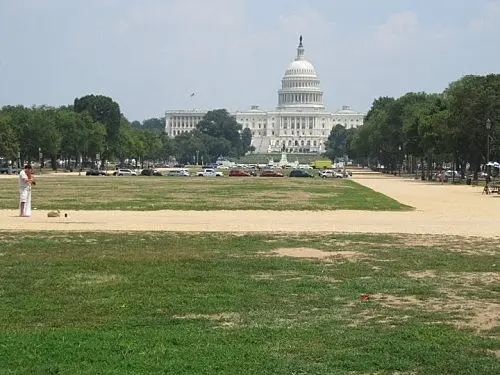
Again, the temperature was north of 40. It was so hot moving between museums that I convinced myself that even the Capitol Building and Washington monument were shaky in the heat.
President Obama got John Key’s name wrong, pronouncing it Keys. Within hours of the meeting, debt ceiling talks broke down again in America and detailed analysis of Obama’s movements for the day left out any mention of his time with Key. The Washington Post picked up a less-than-200-word Associated Press wire story, running it at the back of their news section.
I was spent. New Zealand will rarely be much of a global headline. Resigned, I moved in the direction of a cocktail and a date with an air-conditioned cinema.
Voyages in America: A Story of Homes Lost and Found by James Robinson
$25 RRP, available August 1 from independent bookstores
and voyagesinamerica.com.